
Written By Riley Bernal
Mass-practiced religion is historically dependent on the practitioner's geographical location. Based on this information, the conclusion to be drawn is that religion may just be societal pressure enforced by proximity, even for people who enjoy practicing it. Thus, if it became popularized by mainstream artists to move away from Christianity in 1960s Britain, the public will follow suit, simply because it’s popular.
Rock and roll plagued Britain’s mainstream culture in the 1960s with bands like The Beatles. They quickly became a household name. However, religious leaders despised The Beatles because of their fear of the rock & roll genre. They believed that the twang of the low-toned bass paired with the kick of the drums released cerebrospinal fluid, causing an excess of hormones that led to an increase in teenage fornication. Public assemblies of vinyl burnings of the Beatles occurred, as a symbol of rebukement of Satanity.
Part of Britain’s fear regarding the Beatles’ music stemmed from the Indian influences audible in their sound. George Harrison’s incorporation of a sitar on the song Norwegian Wood (This Bird Has Flown) sparked controversy among fellow artists but also among critics. However, Britain’s concerns regarding the Beatles’ affiliation with communism was futile, as nothing came of the matter throughout the entirety of their career.
What the Beatles did spark with their music was an ideological revolution, advocating for prioritizing self-actualization over religion. This movement was led by none other than George Harrison, the Beatles’ lead guitarist. The spiritual experimentation of George Harrison showed the public that living a meaningful life didn’t require an absolute profession of faith to one religion. Harrison’s inspiring wave of self-actualization moved the West away from their traditional monochromatic views of religion.
One feature that the public can often sense in a celebrity figure is authenticity. Harrison’s devotion was honorable because of how obvious it was that he loved practicing it. His wife, Olivia Harrison, describes that he was extremely satisfied with the life he lived, and following his death, a candle wasn’t necessarily because the light of his spirit illuminated the room.
Although more research is required to directly link statistics regarding a spiritual awakening to musical figures such as the Beatles, it is clear that the Indian influences evident in their music contributed greatly to the diffusion of cultures from 1960 to 2000.
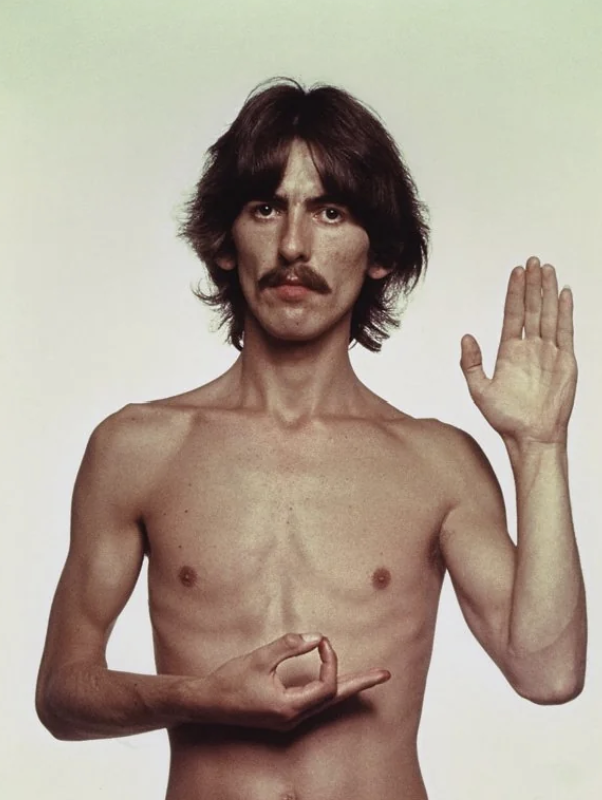
George Harrison, 1967, taken by Richard Avedon
This image captures English musician George Harrison making a mudra with his hand, expressing his interest in Eastern spirituality.
